Review: Alipura

Alipura

Usually, in small places like Alipura, the pace of life tends to be sluggish, and even when you meet people after years, you’d notice little changes in them…Now, that’s what didn’t happen to the family this year.

-Gyan Chaturvedi

Alipura‘ is the story of a small Indian village in the state of Uttar Pradesh with a middle class Brahmin family at its epicenter. The story starts with the arrival of a marriage prospectus for the young and pretty ‘Binoo‘ who is the sister of four brothers ‘Guchchan‘ (who’s devoted to Gods and divinity), Chhuttan (who’s a Dharmendar fan and overly sarcastic), Chandu (who’s always busy in studies) and Lalla (who’s a bodybuilder). Her mother is a widow and is balancing the household with the little treasure she owns and meagre rent from tenants.

The way these boys live their life resembles many men in the Indian household who are good for nothing but are treated with extreme prestige due to their lineage, little accomplishments or because they are men. The author has described every little thing that happens in Alipura or villages like it in graphic details be it the scene of train stations, police stations, the roads, the hygiene of people, domestic abuse treated as casual affair, love affairs, gossips, summers, school and college examinations, dacoits, corruption, jails, marriages etc

The book is filled with funny anecdotes. Each character has their own story which intertwines with the lives of many people of their village making it an interesting read. The characters make you feel annoyed because of their mindset and you may feel extreme remorse for the two women of the house.The story Chaturvedi is narrating is actually a scenario of most Indian households be it of the past or present, be it of city or village. This is something not many would try to understand because the book has a lot of casteist remarks and male chauvinism which is intolerable in today’s world, and cannot be gulped down as humour. But the moral is something the author leaves up-to the readers to grasp.

#readingfatima

The book is translated by Salim Yusufji who has tried his best to do justice to the book. The book is originally written in Hindi as ‘Baramasi‘. The cover art is outstanding.

Review: 1984

1984

“The Revolution will be complete when the language is perfect. Newspeak is Ingsoc and Ingsoc is Newspeak.”

“Don’t you see that the whole aim of Newspeak is to narrow the range of thought? In the end we shall make thoughtcrime literally impossible, because there will be no words in which to express it.”

SpoilerAlert

I guess every rational thinker after reading the end of ‘1984’ falls into a pool of despondency and almost loses the vigour to read further i.e the Appendix- Principles of Newspeak which starts like this…

“Newspeak was the official language of Oceania and had been devised to meet the ideological needs of Ingsoc, or English Socialism.”

I’ve read the book as a teenager and at that time everything felt crap to me, the concepts of ‘doublethink‘ or ‘artificial earthquakes’ didn’t really feel like dystopian but lunatic. But in the times we live the genre of the book feels contemporary yep definitely fictional but realistic fiction

I won’t talk about the book, there’s enough summaries available for it nor push it as a recommendation. It’s a masterpiece so you know.

Sometimes I feel the book is used more by institutions like Ingsoc as a ‘book of ideas’ than the Winston’s, Julia’s and Proletarians of the world for whom the book is written. The thing that has always fascinated me about the book is the ‘End’.

At first I used to believe it’s a hasty end concluded by a person suffering from TB. The author just didn’t want his thoughts to go waste as an incomplete #novel so he just wrapped it up but then he should have stood by the title, ‘The Last Man In Europe’. But then there’s the appendix which makes you believe in ‘1984‘.

Maybe just maybe the language did make the comrades of ‘Outer Party’ commit continuous ‘thoughtcrime‘ and somewhere down the line they got tired of torture, confessions, bringing everyone to Room 101. People like Parson had also committed a thoughtcrime in his sleep so maybe almost every member of Outer Party either got shot or the word of Winston came true that

‘It is impossible to found a civilization on fear and hatred and cruelty. It would never endure. It would have no vitality. It would disintegrate. It would commit suicide.’

And now the only people who remained were the proles and the Inner Party, and eventually as Winston said ‘If there was hope, it must lie in the proles’ and proletarians did get educated because of lack of comrades so eventually instead of a few nuclei of discontent who were marked down by Thought Police and eliminated, there was a swarm of discontent proles who thought and spoke ‘Oldspeak‘.

So ultimately the ruling power fell from power by the third way.

These are my thoughts….

Wonder if anything in contemporary times could happen this way. The one thing that I’m yet clueless about is the third sentence Winston wrote on the white slate. 

#readingfatima

So what do you think happened at the end???

Review: Colours Of Red

Colours Of Red

The clock stops when you are in Bastar. But the clock has never started ticking for the hundreds of thousands of people who are Bastaria. In this age of terabytes, life moves here with the speed of kilobytes. You are amazed at many things here, but the most amazing is the Bohemian spirit of people from Bastar.

-Rakesh Kumar Singh

Colors Of Red‘ written by a serving CRPF officer is a story of Bastar, it’s villagers, the Maosist of the region, the carelessness of the government, the life of para-military and government officers here through the eyes of a Commandant newly posted in the area which is also called as ‘Dandakaranya‘ meaning ‘forest of punishment’.

Throughout the book the author has boldly narrated the ground zero condition of the area which makes you wonder how regions full of beauty and resources like ‘Bastar‘ continuously remain underdeveloped due to corrupt politicians, blind attitude of the authorities and fear and disbelief for the government among poor villagers that is gambled by Naxalite into rage turning these areas into war zones such that the place receives enough funding from corporates and government yet nothing changes. The author uses a satirical tone to point out the flaws in the defense, intelligence and administrative units which makes an impressive counterpoint against what we are made to believe as citizens.

#readingfatima

At the heart of the story is the life of a young commandant who’s not hypnotic about martyrdom or glory but believes firmly in the protection of the locals and his officers. He dearly misses his family. A love affair that blossoms due to loneliness and friendship and nevertheless an unforeseen betrayal.

Review: Lights! Wedding! Ludhiana!

Lights! Wedding! Ludhiana!

People from Ludhiana will be amongst the first to hold marriage ceremonies on the Moon and Mars once human colonies are set up there and commercial space flights become available. However, there could be many complications arising from this development. Ludhiavanis would insist that scotch whisky be served during the space flight along with tandoori chicken .

-Jas Kohli

‘Lights! Wedding! Ludhiana!’ is a humorous story of a middle-aged husband from Ludhiana who’s been caught red-handed by his ostentatious wife, flirting with his ex-gf from college years on a day they are supposed to attend a pompous wedding of a close family member in the city.

Kushal is a JNU alumni who believes and follows a simple life avoiding any kind of extravagance to save mother earth. On the other hand his dysfunctional family follows a lavish lifestyle just like the uber society of Ludhiana and absolutely hates Kushal’s lack of interest in business which is making them poorer every year. Although Kushal is very happy with his family life and is married to a beautiful woman, he falls back towards his Ex.

How Kaushal saves his marriage and also wins in his efforts to teach the youth of the city to give up extravagance is a delight. The author has unabashingly narrated the life of Ludhiavani’s who are always rolling in money and finding excuses to spend their riches in the grand Indian style over property, cars, clothes and weddings.

The book is just like Dr. Jas’s previous book, a funny story but this time based on Ludhiana, a dysfunctional family and the untold secrets between couples. His in-joke of cosmetic treatments and doctors can be felt throughout the book.

I loved the cover art it captures the essence of the book perfectly. An amusing feel good book to enjoy after a weary day.

Review: The Psychology Of A Patriot

The Psychology Of A Patriot

The contestation against secular and democratic values of India by jingoists is largely on the grounds that India should become a Hindu Rashtra because of its historical roots. But a historian who flipped back the pages of history and came up with her research works that questioned such legitimacy became a target of unprecedented vitriol. That’s the nature of jingoism that crushes dissent and rational thinking in the name of blind patriotism.

-Saket Suman

So what exactly is patriotism?

Is it simply unconditional love towards the land we live in, having blind faith in the people we elect as representative of our country and glorifying the martyrs/sportsperson?

Or is it respecting the constitutional and human rights of every citizen of the land, having the elected members to be answerable to grievances of the people and glorifying the contribution of every citizen who make/have made the country shine?

‘The Psychology Of A Patriot’ is a book that helps you understand what does it mean to be PATRIOTIC according to the ‘Constitution Of India’ that was carefully framed by the people who secured Independence Of India, how throughout the history of India political powers have played with the values and morals of the Indians ridiculing the ambiguous emotion called ‘Patriotism’ and how patriotism and nationalism have become interchangeable terms in contemporary India.

The author talks briefly about the 1857 revolt which sowed the seeds of revolution in India, sites important freedom movements and the men/women behind the task, the values of Gandhi, effects of his sudden killing, the making of Constitution of India, 1962 India-China War,  the rise of Indira Gandhi and the fall of India during ‘Emergency‘, the arrival of jingoism in Indian household, the failures and treachery of the current government in the name of national interest.

By dissecting all the events of the past and present the author tries to preach and teach just one thing ‘Patriotism‘…that’s it. The life and morals of a few luminaries is often repeated throughout the book which might propagate prejudice in the mind of those who especially dislike these men and women. Saket’s own thoughts are so profound and sorted that if the book was written purely in his own words it could have been more impactful.

Nevertheless this is a unique book and a must read for the youth of India. What I really loved is the tone of the book; it’s neither extremely preachy nor biased or dogmatic.

There is nothing singular about our country, but we are still one in spirit, in the vibe that makes us Indians.

-Saket Suman

Millenial Professional’s Search For Passion

Millenial Professional’s Search For Passion

WHAT IS THE PURPOSE OF YOUR LIFE?

WHAT IS YOUR PASSION?

YOUR CALLING?

Have you ever spent hours and years just breaking your head to find the answer to every Gen Y/Z’s greatest dilemma?

I’m sure most of you might have gone through it…some of you might be lucky to have found the answer…and some of you like me might have completely/arbitrarily absconded from the idea.

Back in 2017 I would spend days after days sitting in my cubicle in my Dental clinic scribbling pages after pages annotating what I believed were my skills, my gifted talents, things I believed I’m passionate about and foolish ideas I could grab from the internet that has helped people achieve success and fame overnight. I believe most of the youth in India who had started there startups/jobs with a modest/meagre income would have gone through it. Thanks to the 2016 overnight ‘Demonetization Call‘ made by Central Govt. Of India crashing the economy and creating a zero cash scenario in the market.

The hasty decision created such a fuss in the country that people would rather suffer pain than part money for a dental treatment.You would understand my plight if you were someone who had just started a venture of a retail type during those days or if you happened to be a dentist practicing in India where convincing patients for aesthetic and non-emergency functional treatment is as good as convincing your three-tiered family for an inter-caste marriage.

https://www.indiatoday.in/business/story/demonetisation-three-year-anniversary-economic-slump-gdp-unemployment-negative-growth-outlook-1617099-2019-11-08

Anyways That’s ‘Life‘ and you learn to live through it anyhow and somehow I, like millions like me (grace the Indian population) , had survived that grim period.

But it left me with a permanent disappointment and dissatisfaction that the ‘Academic Laurels’ I’d earned spending years lacked something…or I lack skills to monetize it to a whooping success…or it’s just not my thing like how can people be sure what would be best for them at the age of 17…sigh

Over years I worked with dissatisfaction to a point I almost gave up what I did…I then started pursuing a career in things I had jotted down in my ‘stressful moments’ as my TRUE CALLING…that would unleash my MAGICAL POWERS.

I tried learning several skills. Loved doing them for a while but it didn’t give me any money, not even a quarter of what I earned drilling and restoring teeth. You need riches right isn’t that what you keep reading all over internet, magazines and newspapers

“Success Stories Of People Who Followed Their Passion Turning Them Into Millionaires”

If you’ve gone through this Catch-22 like situation and still not found your calling you must have realised and learned One thing by now

All These Success Stories Is A Myth (it’s not  that those people are fake)

The myth is NOT EVERYBODY WILL HAVE A SUCCESSFUL PASSIONATE CAREER AT THE BRINK OF YOUTH.

NOT EVERY PASSIONATE PURSUIT REAPS A MONEY PLANT nor does the gusto stay 24*7 for 365 days or lifetime…I’m not bluffing

All you need to do is HAVE FAITH IN YOUR FATE…nothing happens in your life for no reason…even if the subject you graduated in sucks or wasn’t your choice remember it still gets you bread and butter.

Keep Flowing With The Current And Polish Whatever Little Skills You Have. You Will Discover Your Happy Path When You Are Not Searching For It. Just Keep An Eye On Things People Come To You For Help Or Appreciate You About.

Eventually one day the tide of world/society will change and it might bring success for you…

Or someday you’ll find the keys of closed doors in the corner you didn’t look…

Remember ‘Mediocrity‘ didn’t kill anybody, it’s the disappointment we carry that leaves us stressed.

FLOW

AND THE PASSION WILL FOLLOW

#readingfatima

Review : Uncle Pai

Uncle Pai

‘Should we stop using a tool as useful as a comic just because it can cause harm?’

-Anant Pai

Uncle Pai‘ is the biography of the legendary man behind the popular children’s comic book ‘Amar Chitra Katha‘ written by Rajessh Iyer. “Uncle Pai” as he was unanimously referred to by his readers in letters and seminars was also the pioneer of many other children’s comics and magazines of the 1970s and 80s like the Indrajal, Tinkle, PARTHA magazine and Rang Rekha syndicated strips. The story of one man who had the vision to cater Indian content to the children of India in the form of comic books when an idea of such sorts was lowly and outlandish.

The book outlines his entire life from a child, his education, career as a journalist in ‘Times Of India‘, making  of ‘Indrajal Comics‘, his married life, giving birth to his dream project ‘ACK’, work life and his ethics, love for reading, storytelling, his other projects and the pruning of a revolutionary comic book era.

Before one should dive into this book one must know what was ‘Amar Chitra Katha’ (a simple Google Search could help) nevertheless I’ll brief you about it. ACK comic magazine was based on famous stories taken from Hindu mythology, Indian history and heritage. I’ve never read any ACK comics, I belong to the ‘Champak magazine’ generation but now I’m intrigued to read them (the contents of the book were also honoured by UNESCO in those days).The book discusses in brief what are the contents of Tinkle, PARTHA magazine etc.

The author has done a wonderful job by maintaining an equilibrium so the biography doesn’t read like a glory story nor does it feel like tasteless banter. There is a lot to learn from the life of Pai especially his equation with his editors, employees, cartoonist, school authorities and IBA heads HG and GL Mirchandani who gave wings to his dream.

I loved the way interesting facts or incidents about Pai’s life are displayed in Box Copy at the end of each chapter giving the book a magazine layout feel. The narrative style of the author is admirable, the book doesn’t get boring at any point. I particularly admire this because most readers avoid reading biographies for it’s tedious tone and it would have been a shame if the life of such a colourful mind was written insipid.

Recommended to everyone who wants to read about the great storyteller Anant Pai, ACK, Tinkle, life of comic artists of the 1970s-80s and anyone who wants to start reading auto/biographies.

#readingfatima

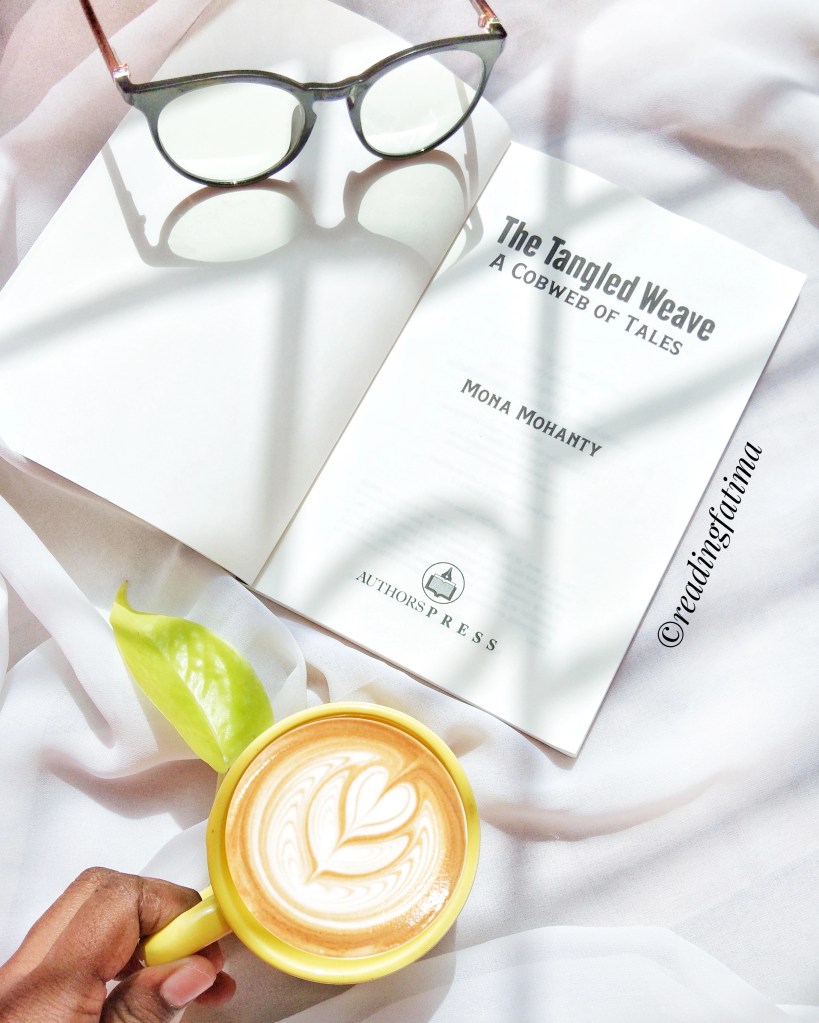
Review : The Tangled Weave

The Tangled Weave

‘The Tangled Weave’ is an anthology of 24 tales neatly written by Mona Mohanty conveying the message of love, strength, karma and respect. Each short story is unique, having a varied subject line,  evoking a different emotion as you complete reading them.

The protagonists of the stories are mostly female and the plot revolves around human relationships. The author has addressed many issues from domestic abuse, philandering, animal love, friendship, kindness towards strangers, misunderstanding in relationships and fate. Within a few words the author narrates a gripping tale often bombing the climax on the last line, which I loved.

As a human we all romanticize the idea that the death of the toxic person in our life will end are problems or an acquaintance or stranger would give us the elixir of happiness but that’s not how troubles end in real life. I wish the stories had more realistic elements.

#readingfatima

But if you are a person who loves ‘Happy Ending‘ and ‘Karma Believer‘, this book is for you. Lucid language in the book. The stories are hardly 3-4 pages long which makes it a perfect book for beginners and short story readers.

Review : Vultures Of Paradise

Vultures Of Paradise

Our ignorance has converted us into waste-producing machines. We are robots fuelled by avarice and indifference, who only want to possess more…and more…and more…And at what cost And why?

-Atulya Misra

Vultures Of Paradise‘ is the story of a young well heeled Indian origin girl who overnight becomes the richest woman in the world featuring in Forbes after the sudden death of her father, a Steel Industrialist. In order to cope with the deathblow for which she blames herself and to prove the world her worth, the protagonist ‘Neha‘ decides to create her own unique business venture.

After dwindling with multiple business ideas and a strange incident that takes her to Bombay and the Zorastian community’s ‘Tower Of Silence‘. She decides to turn into a ‘Vulture’ and build her empire around waste management, the biggest problem faced by the world. Soon her company gets multiple offers and funds but her team has no plan where and what is to be done with the dump.

Later Neha makes a ‘Three Clause’ surreal deal with the king of a country in Central Africa and creates the biggest dumpyard in the world in his country. Everything runs smoothly and promising, flourishing manifolds until a sudden radioactive leak occurs causing widespread radioactive exposure not restricted to one country but the entire world. How does Neha and her team come out of this catastrophe which is the result of their greed, lack of knowledge and incompetence makes one ponder and understand a lot about world politics, privilege, various types of garbage and the inhumane activity of humans.

The book is more of a contemporary fiction with elements of mysticism and Vedic Astrology defining some important events in the story. I wished the author had invested more into framing drama around the world problems due to waste, relatable characters and solid ground solutions.

#readingfatima

I loved the cover art. The story comes with a repetitive message of using less resources and respecting Mother Earth. Nevertheless the wide experience of the author is reflected in the various journeys Neha takes throughout the book.

Review : I Am Invincible

I Am Invincible

The realisation and wisdom that difficulties and overcoming them are what make our ‘passing through the planet’ the most amazing part of human experience.

-Neelam Kumar

‘I am Invincible’ is a compilation of excerpts from blogs and books of cancer and adversity fighters, interviews by the author herself of these amazing people sharing the most miserable part of their life and their road to recovery and happiness.

The author opens the book narrating her own story of fighting cancer twice and shedding the label of “poor widow” into “capable professional”. She calls herself a ‘Thriver‘ and with that puts forward stories of 13 real life heroines and heroes to help us understand and realise that life is beautiful.

The author has also penned down medical views of renowned Indian doctors on each subject which is the highlight of the book.

#readingfatima

Trigger Warning: Stories of Child Cancer  Breast Cancer, Throat Cancer Survivors, People Suffering from rare diisease , Transplant Story, domestic abuse and rape Survivor

To say that a few selective stories shattered my heart would make me sound hypocritical. But the stories of Shweta Chawre (paediatric osteosarcoma survivor) and Charitra Das (Paediatric ALL survivor) really shattered me. It made me realise the unpredictability of life and the endurance of the human body irrespective of age.

The story of Nalini Satyanarayan who suffered from Throat Cancer due to passive smoking makes one apprehend how smoking kills both the active and passive smoker. Shalini’s narration of a years of domestic abuse and Sapna’s open addressal of her gangrape makes one question the norms of society.

What is really amazing is that each one of them, though a survivor, are doing everything within their means to create awareness about the disease, treatments and fighting the stigma.

A book which should be read by many people for these are stories of real life warriors.

Design a site like this with WordPress.com
Get started